Monday, March 5, 2012

Gender confusion on Inkberry

A couple of years ago, I was designing a garden for someone who was interested in creating a nature-friendly landscape in her backyard.  One of the plants that I chose was our native  Inkberry shrub - Ilex glabra "Shamrock".  The dark colored berries (actually drupes) are  a valuable food source for birds and small mammals in late winter. 
However, lo and behold, the five shrubs I planted produced no berries, even after two years.  It suddenly occurred to me that (duh!) since Inkberries are dioecious (separate male and female plants), the females needed a male for polination!  Why didn't I think of this before?  Thus started my quest for a male inkberry.

It seemed to be an easy enough task...just go back to the nursery and buy a male plant.  Not so easy, as it turns out.  It seems that Inkberries are primarily hybridized and sold for their foliage value - bright shiny evergreen leaves - and not so much for their fruit.  Most nurseries don't even sell males - or even know which Inkberry is a male.  A check of the Ilex glabra section in Dirr's Manual wasn't much more help...of the 20 odd cultivars listed, nine are labeled as being female; eleven have no gender mentioned or have an undetermined sex.  A recent internet search continued the confusion:  the cultivar Nordic 'Chamzin' is listed in Baileys Nursery catalogue as being a male; Weston Nurseries lists 'Chamzin' as having black berries.  Sylvan's Nursery doesn't list the sex of any of their Ilex glabra cultivars; interestingly enough all of the Ilex verticillita cultivars are clearly labeled as male or female. 

I mentioned my confusion to Sue Gordon at URI, and she initially thought that males would be present in sufficient quantity in nature to provide the needed polination.  However, she has come to the conclusion that the nursery industry, and the native plant nursery industry in particular, needs to pay closer attention to this.  She has started propagating male plants; and is making an effort for other nurseries to join in the cause.

The flowers on all Ilex species are small, fairly inconspicuous and somewhat similar which probably leads to the confusion.  Male flowers, it seems, occur in clusters (see photo above) while the female flower is generally found singly on a stem.  Other than that, the only real way of identifying a female is the presence of berries.

Thursday, January 26, 2012

Gardening with a busy life - even in 1906

An issue which is commonly heard amongst people who garden is the desire to make their garden lower maintenance.  We all tend to lead very busy lives, and certainly don't want our gardening hobby to demand too much of our time.  I, for one, have thought about days gone by, when life was slower and people seemed to have more time for things like gardening.

Or, did they?  As I mentioned in my first blog post, an interest of mine is gardening history.  I was very surprised when a 1958 garden book talked about the need for low-care gardens because of modern life with both mother and father working.

More recently, I was browsing a 1906 book entitled, Houses and Gardens, by a well-known British architect, and artist and furniture designer, M. H. Baillie Scott.  Scott grew up in a farming family, and after becoming an architect eventually joined William Morris and John Ruskin in the Arts and Crafts movement.

It is clear that Scott is drawn to the simple, natural look in the landscape as well as interior of the house. But interestingly, he repeatedly talks about the need for a lower maintenance garden; particularly for those who don't have professional gardeners.  His solution? Less lawn, and a garden that follows Mother Nature:

"...the best type of garden would be one which maintained it's beauty with a minimum expenditure of labor"

"...the whole situation seems to point to the natural or wild garden, with those departures that may justify themselves by their usefullness or beauty, secured without undue cost of maintenance."

"A garden is expensive to maintain in proportion to it's artificiality and in the extent to which it includes mown lawns, bedded-out flowers, and clipped hedges."

"I do not wish to under value the beauty of a well-kept lawn; but it will be well if the smaller householder....should realise that [a lawn] implies a certain cost of maintenance, and that a garden can be formed, and not a bad garden, either, without any mown grass at all."

Interesting...and still good advice for us over one hundred years later.

Sunday, May 15, 2011

Really Natural (and Easy) Pest Control

Anyone who has been to my garden lectures knows my philosophy of the importance of appreciating the role of insects in our garden.  I refer to the work by entomologists Frank Lutz (of the N.Y. Museum of Natural History) in the 1930’s and later by Gary Hevel (of the Smithsonian Institute) in the 2000's who spent years collecting insects in their NJ and Maryland backyards, respectively.  Both of them found thousands of different insect species during their study period, a number which is probably astounding to most of us.

An entomologist with the USDA, Eric Grissell wrote a fascinating, informative and comical book on the topic, called Insects and Gardens.  Not only is it enjoyable to read, but you will never look at an insect in your garden the same way after reading it.  I highly recommend it for all gardeners.  He has a new book entitled Bees, Wasps and Ants: The Indispensable Role of Hymenoptera in the Gardens  which I am looking forward to reading.

The essential thought of all these entomologists is that if we learn to appreciate the insects who come to our garden (along with the myriad of other creatures above and below ground that make up our garden ecosystem) we can have them help us in our control of unwanted pests. 

I have had two experiences with using insects (unwittingly) for predator control in recent years.  The first time was when we were selling our house, and my beautiful honeysuckle was covered with aphids.  Before I had time to buy some insecticide, the lady beetles descended on my plants and took care of the job for me.

And the second time was last week, when I noticed the new growth on my roses was covered with aphids.  This time, I thought about hosing them off, a method I heard about at the Arnold Arboretum.  But once again, before I had a chance to do anything, the aphids disappeared…I never saw who devoured them this time.

Wednesday, March 23, 2011

On the Sustainability of Development

Today’s Providence Journal has an article summarizing the research of students at Brown University’s Center for Environmental Studies on the causes of the historic flooding in Rhode Island last spring.  Their conclusion is that the flooding was human induced, following centuries of deforestation and urbanization along the floodplains of the affected areas.
                Coincidentally, yesterday I attended a workshop hosted by RIDEM and CRMC on the new Stormwater regulations, which have been designed to minimize both flooding impacts and environmental degradation from storm water runoff from new impervious area.  The workshop began with a presentation from NOAA’s Northeast River Forecast Center on the same topic - the causes of the March 2010 flooding.  The presenter reported the same conclusion…the flooding was precipitated by a series of storm events but was primarily caused by urbanization in the floodplains.
                The town that I grew up in New Jersey often had flooding in the low-lying areas of the downtown until the Army Cory of Engineers came in and widened and channelized the beautiful stream that ran through the town park.  It eliminated the flooding but destroyed the steam habitat.  I remember hearing as a young girl that the Native Americans in that region avoided this low-lying area because they knew of the flooding potential.
                At the storm water workshop yesterday, there was a presentation of two possible subdivision scenarios on a real parcel in Smithfield.  The original design had an average lot size of 3.3 acres with 3200 linear feet of road.  The alternative design reflected the avoidance of significant environmental impacts by reducing lot size and road length.  Instead of an average 3+ acre lots, the house sites would be about half that size.  The resulting reconfiguration of the subdivision would lead to the preservation of over 50 acres of open space in one large area.  The presenter commented, however, that the marketability of the smaller lots would likely be difficult because they no longer were “estate” size lots.

Suburban Sprawl

                Rhode Island is already one of the most urbanized states in the country.  As long as what little undeveloped land we have is continued to be developed and people continue to demand large lot sizes, our natural undisturbed areas will be lost forever.  Isn’t it somewhat ironic that “green” home construction is the big buzz word in the high-end residential market?  How often are these “green” homes built in areas where precious habitat has been destroyed in order to accommodate this development?  How green is that?
                It is easy to blame the introduction of plants from Europe and Asia for the loss of native plant species.  But as Peter del Tredici says in his book, Wild Urban Plants of the Northeast, “spontaneous plants have become the de facto native vegetation of the city”.   As much as we tout the inherent adaptability of native plants to our area, there must be a reason why introduced plants have managed to out-compete natives in so many areas.  Could it be because disturbed areas bear little resemblance to the native habitat and environment which once existed?
                If we are interested in a really “green” effort, it would seem that we need to make some hard decisions about where we live and how much land we preserve as habitat for our native flora and fauna.  It is really the only truly sustainable solution to preserving what we care about.

Friday, March 18, 2011

Some benefits of a lot of snow

           As much as many of us dreaded the heaps of snow we had in January, I discovered a pleasant surprise a week or so ago on my south facing garden.  The lettuce seeds that I planted last August, and which really didn’t amount to much by the cold weather, had survived under that nice thick blanket cover and were ready to hit the ground running as soon as the temperatures were over 45 degrees.  After discovering the first plant, new ones have emerged over the last week.  I should be able to make a nice salad by the time I would ordinarily be just planting!
                Why is that?  Well, the nice thick cover of snow that we had for a good six weeks or so kept the ground under it at a steady 32°, and kept things nestled underneath protected from the nasty, chilling winds and ice we had.  I checked the USDA hardiness zone map to see what the equivalent zone would be with a low temperature of 32° - and was surprised to discover that it would be Zone 10a!...which is Naples, Florida and Victorville, CA according to the National Arboretum.  So while the rest of us were dealing with the arctic wintry weather, our little plants under the snow were enjoying a nice respite in the southern weather!
                Of course, other things that were above ground far enough to get pelted by the snow (but not covered) really took a beating.  I’ve never so many broken limbs and split branches.  Good business for tree care companies, I suppose…

Sunday, March 13, 2011

Native Plants in the Garden

I had an opportunity to hear Debbie Edelstein (The Executive Director of the New England Wildflower Society) speak yesterday at the RI Wild Plant Society annual meeting.  Her talk focused on the importance of genetics in choosing native plants, and she talked about the endeavor by plant scientists and ecologists to use ecoregions as a basis for studying and classifying flora and fauna.
                There is an increasing amount of dialogue and interest among those in the plant community on the value of using native plants in our suburban gardens and backyards.  The use of native plants, and their role in the garden habitat is actually a fairly complex issue.  Debbie mentioned in her talk that NEWFS personnel are often asked about where, when and how many native plants to use.  The answer they give is… “It depends”.
                The premise that is put forth by many people and organizations is that native plants are much better adapted to our local soil and climate, are important for native insects because of their coevolution, and will help to preserve our native wildlife population.  Doulas Tallamy, in his book Bringing Nature Home asserts that our native plant, insect and wildlife population is in danger unless we transform our suburban yards into native habitats designed for biodiversity.  He contends that a native plant is almost always a better choice than a non-native. 
                On the other side are people like Peter Del Tredici of the Arnold Arboretum, who argues in his book Wild Urban Plants of the Northeast that our landscape is so disturbed that it bears little resemblance to pre-European habitats.  He believes the reason “non-native” or “spontaneous” urban plants become so prolific is because they are better adapted to the altered landscape.  It seems logical that “non-native” plants wouldn’t be so prolific if they weren’t suited to our environment.
                Both sides present compelling facts and theories.  The issue is one that I believe needs to be reflected on by us, as gardeners, as we create garden habitats.  However, as mentioned above the issue is not always so simple.   Here is why:

·         Plant Genetics: As scientists are now realizing, the genetics of a plant can be equally important to its role in the ecosystem, and so a dogwood tree which has been grown from plants collected in Florida will have significant genetic differences from the same plant grown from seeds collected in New Hampshire.  For example, it will not be as cold hardy and will probably flower at a different time. 
·         Seed source availability: At this time, it is almost impossible to get plant material from native seed sources, and as a result the “native” plants that we buy at the nursery are from stock outside of southern New England.   (NEWFS is attempting to remedy this problem at their own , Nasami  Farm nursery, by harvesting and propagating local seed-sourced plants)
·         Native Cultivars: The nursery industry has spent a considerable amount of money developing “new and improved” hybrids of native plants.  Every year there seems to be plants in new colors, sizes and shapes.  These hybrids are generally what are available to consumers, and there has been little research on the impact of hybridized plants in the ecosystem.   An example of a potential negative outcome would be Winterberry plants that are developed for larger berry size so that they are more ornamental – but whose berry has become too large for some birds to use it as a food source.

So, what do we do?  The NEWFS tells people that the over-riding principle that should be used is to “do no harm”.  How can we do that?

1.       Educate yourself about native plants – join the R. I. Wild Plant Society and participate in their walks and talks.  Take classes at the New England Wild Flower Society.
2.       Read and keep abreast of the latest research in the field.  The NEWFS website: http://www.newfs.org/learn  is a good resource as is the RI Wild Plant Society http://www.riwps.org/nativeplantlibrary.htm and the University of Florida cooperative extension website  http://edis.ifas.ufl.edu/ep297
3.       Avoid planting cultivars of native plants if you live near an undeveloped natural habitat, particularly if the planting is part of a restoration project.
4.       Do not use any plant that is known to be invasive in the natural habitat.
5.       If you are planting a native garden to attract wildlife, use plants that are native to the region, and buy at a reputable nursery that is known for native plants.  The RIWPS website is a good resource for this. http://www.riwps.org/index.htm
6.       Try to use plant combinations that would occur naturally in a plant community.  For example, white pine, maple, dogwood, asters, native geraniums, etc. would be part of a forest plant community.  A wonderful resource for this is a book published by the UNH Cooperative Extension, Integrated Landscaping: Following Nature’s Lead

Saturday, March 5, 2011

Now is the time....to prune trees and shrubs

If you didn’t get a chance to prune your shrubs and small trees this fall before the snow arrived, now is the time to do it – before the plants begin to emerge from dormancy.

Even if you did prune in the fall, chances are that the heavy winter snows in January damaged some of your plants branches or stems.  In that case, here’s what you need to do. If the branches are snapped, make a clean 45-degree cut just above a node (a bud or side branch).   If they’re bent, but not broken, you can decide whether to wait and see if they will bounce back in the spring, or you can cut them off now.  Your decision may be based on how important the stem or branch is to the structure of the plant.

I visited one friend’s yard and one of her newly planted inkberry looked like a giant snow monster had stepped on it.  Inkberry can be cut back severely and respond with new growth, so that is what I recommended to her.

Here are some other pruning steps your plants might need:
·         prune lower branches from small trees  - particularly if they are in the way of other plants
·         thin out overcrowded and cross-branching limbs
·         remove any diseased or dead stems
·         prune branches on Japanese Maple to reveal their beautiful  framework

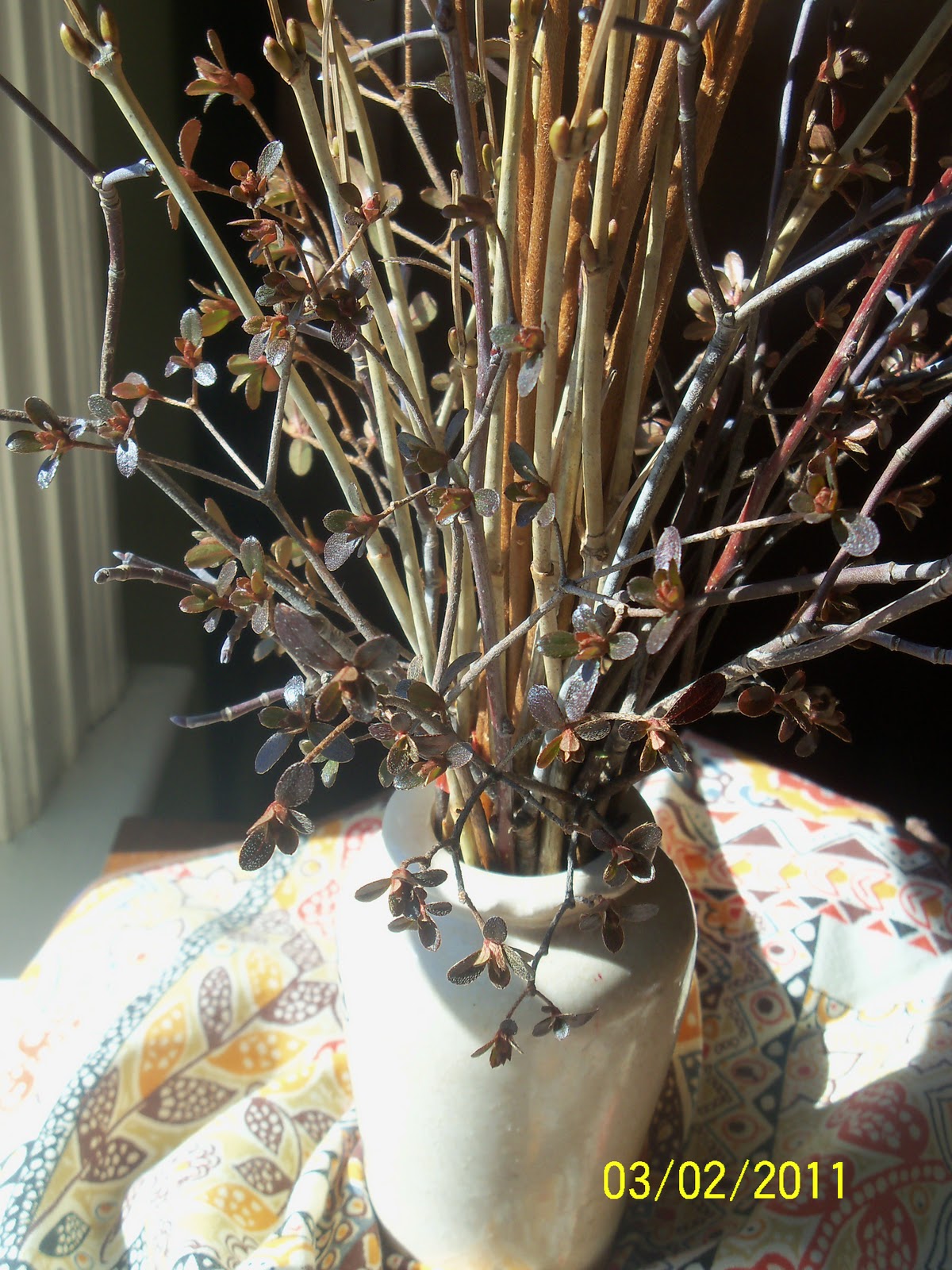
Another idea – use the pruned branches or other different color branches you can find to create a twig bouquet (above photo).  You would be amazed at how beautiful different color stems can look together.  If you include flowering stems (forsythia, dogwood, azalea etc.) keep your bouquet watered, you may be surprised with some forced blooms in a couple of weeks.